How to reverse a car in a straight line
Updated October 2026
Reversing feels odd because the steering seems backwards, and you cannot see where you are going. The fix is simple: go slowly, look where you want the car to go and make tiny steering moves. A car that drifts is corrected early, with a small turn, not late with a big one.
These steps assume right-hand traffic, with the kerb on your right. If you drive on the left, swap every left and right.
Step by step
Set up before you move
Adjust the seat and mirrors, check the way behind through all the windows and make sure the area is clear of people and obstacles. Use your parking brake and brake pedal to hold the car still while you do.
Get the gear right
Select reverse, release the parking brake and ease off the brake pedal. On an automatic the car begins to creep without any gas.
Look where you are going
Turn and look through the rear window, resting your right arm on the back of the passenger seat. Use the mirrors and camera as a check, not as the main view.
Steer in small moves
Put one hand at the top of the wheel. To move the back of the car to the right, turn the top of the wheel to the right. Then bring the wheel back to the middle, because wheels held turned keep turning the car.
Control the speed with the brake
Keep the speed at walking pace or slower. Cover the brake pedal and use it to hold the speed down. If you are unsure, stop; there is no rush.
Finish and secure
Stop where you meant to, apply the parking brake and select P.
Common mistakes
- Over-steering. Big wheel movements make the rear swing wildly. Think in small movements.
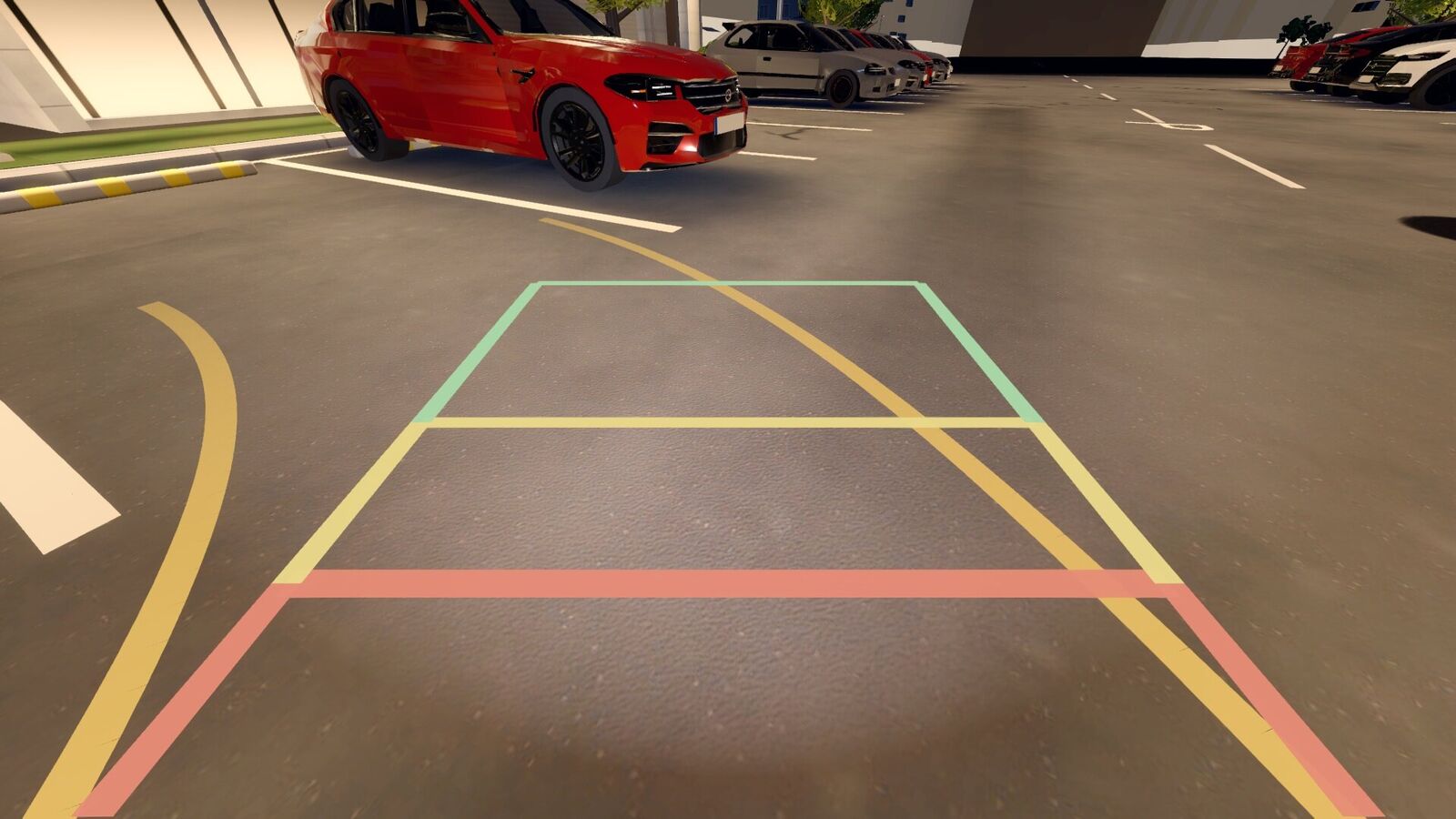
- Trusting the camera alone. A rear camera has blind corners and a flat picture. Use it with the mirrors and a look over your shoulder.
- Going too fast. Speed makes every error bigger. Creep, and use the brake to keep it there.
- Forgetting the front. When reversing, the nose of the car swings out to the side. Check ahead before you steer.
Tips that make it easier
- Pick a fixed point behind you, such as a lamp post or a lane line, and keep it in the same place in the rear window.
- If you drift, stop, steer the other way a little and carry on. You never need to hurry.
- A car’s blind zone behind it can be several metres long; a small object or child may be out of sight.
In the driving test
Reversing in a straight line, usually for a set distance and then around a corner, is a classic test item. Examiners watch for all-round observation, a steady slow speed and staying reasonably close to the kerb.
Quick answers
Which way do I turn the wheel to reverse right?
Turn the top of the wheel to the right, and the rear of the car moves right.
How fast should I reverse?
At walking pace or slower. With an automatic, the car’s creep after releasing the brake is usually fast enough.
Is it okay to rely on the camera?
Use it as a help, not a replacement. Check the mirrors and look over your shoulder, because the camera has blind spots.
Practise it in ParkingAim
The straight reverse lesson is free: a corridor to reverse through, with the instructor reading the position of your car.
- Straight Reversing18 m backwards through a cone corridorFree
Park it for real, without the risk
ParkingAim is a parking trainer for iPhone, iPad and Mac. A calm instructor’s voice talks you through each move in a 3D city, sized to your car. Three lessons are free.

More parking guides
Parking on a hill
Which way the wheels turn, with and without a kerb, and the order that keeps the car where you left it.
Three-point turn
Three moves on a narrow road: left, back right, left again, with the observation to match.
Reversing into a garage
How to line up, steer in and use the door frame as a guide.