Parking test tips: how to pass the parking manoeuvre
Updated October 2026
In a driving test, parking is not about perfect geometry. It is about control, observation and a calm, safe decision. Candidates who practise a fixed routine pass more often than those who rely on feel. Here is how to build one.
These steps assume right-hand traffic, with the kerb on your right. If you drive on the left, swap every left and right.
Step by step
Know exactly what your test asks
Different countries test different manoeuvres: parallel, bay, reverse around a corner or a turn in the road. Check your authority’s test guide so you practise the right ones.
Build a routine
Signal, check the mirrors, look over your shoulder, then move. Repeat the same sequence every time until you do it without thinking.
Use fixed reference points
Know where the car’s corners are. A routine reference, such as the line under the bonnet, removes guessing.
Keep the speed low
Walking pace or slower. The brake does the work; the examiner sees control.
Correct calmly
A small correction, such as a short pull forward, is fine in almost all tests. A panic or a bump is not.
Finish and secure
Parking brake on, gear to P or neutral, signal off, a final look around.
Common mistakes
- Poor observation. The most common reason to fail. Look at every move, not just the first.
- Hitting or mounting the kerb. Slow down, use the brake and judge the distance with the mirrors.
- Speed. Hurrying turns small mistakes into big ones.
- Not practising in your test car. Dimensions differ. Try the manoeuvre in the car you will use.
Tips that make it easier
- Practise on a quiet road with cones or bags at first.
- Rehearse the manoeuvre at the time of day of your test.
- Breathe, slow down, and treat the examiner as a passenger.
In the driving test
Marking schemes differ by country, so use these tips as a base and then check your local test requirements.
Quick answers
What are the most common reasons to fail the parking part?
Poor observation, hitting the kerb or another car, and going too fast to stay in control.
Can I stop and correct myself?
In most tests, yes: a small, safe correction is better than a rushed finish.
How do I practise without a car?
In ParkingAim you can practise every move in 3D, with the same checks the examiner looks for.
Practise it in ParkingAim
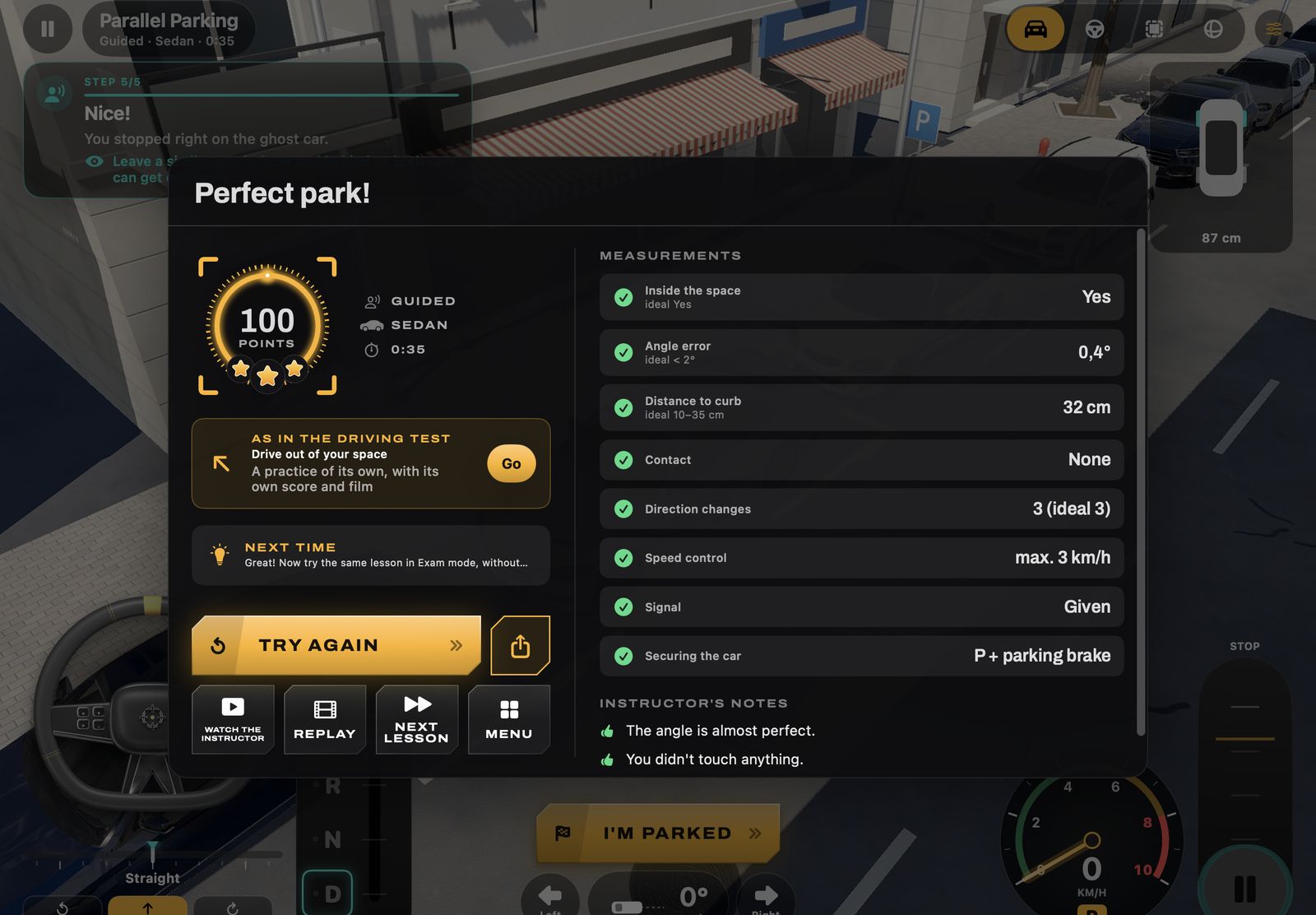
ParkingAim measures the same things an examiner would, such as angle, centring and distance from the kerb, and the instructor explains each one afterwards.
- Parallel ParkingThe classic 45° method, between two carsFree
- Back-In Perpendicular ParkingThe safest way to park in a parking lotFull Version
- Straight Reversing18 m backwards through a cone corridorFree
- Turn Around in a Narrow StreetThree moves, then stop in the FINISH boxFull Version
Park it for real, without the risk
ParkingAim is a parking trainer for iPhone, iPad and Mac. A calm instructor’s voice talks you through each move in a 3D city, sized to your car. Three lessons are free.